
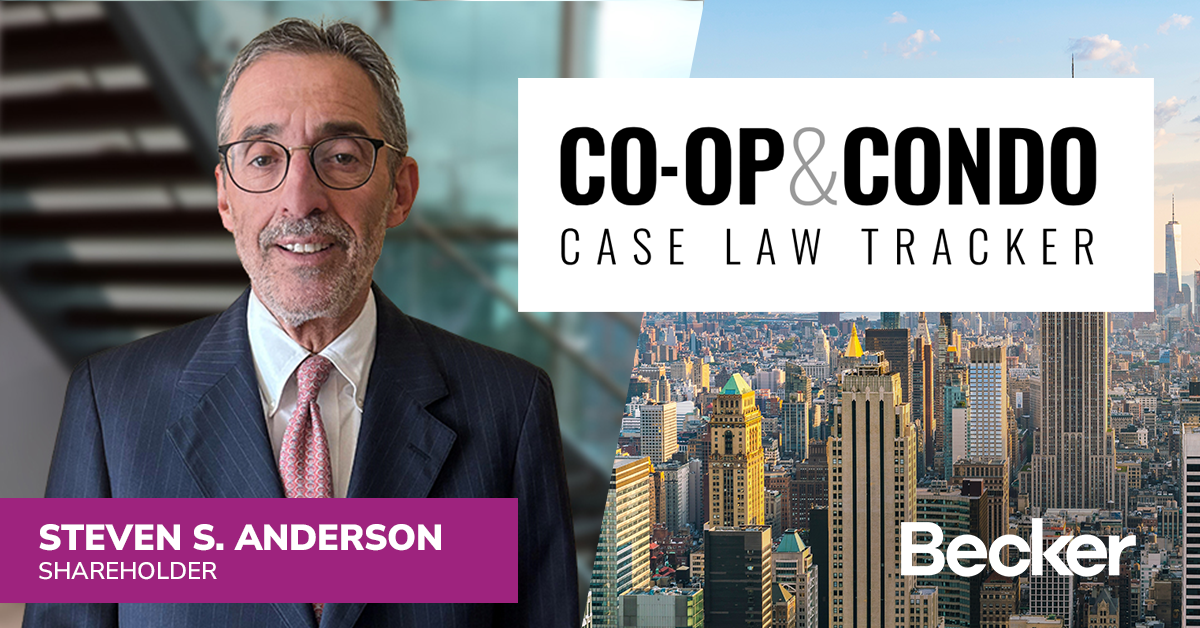
Becker’s Steven S. Anderson Featured in Co-op & Condo Case Law Tracker: Election Dispute Produces Competing Co-op Boards
WHAT HAPPENED: The courts are fond of saying, as the highest court of the state has itself said, a cooperative is a “little hub of democracy.” Well, as we all know, that means a lot of fighting these days. And that is what has been going on with Inwood Tower, a Mitchell-Lama residential cooperative in Fort George/Upper Manhattan, for over a decade.
Most recently, the cooperative board of directors and insurgent directors have been battling in court for governance control. There was a failure to achieve a quorum at the December 2022 shareholder meeting, leaving a nine-member board in place. Alas, no quorum was achieved at the 2023 annual shareholder meeting either, and the insurgents had had enough and served notice of a special meeting—after the board refused to do so at the insurgents’ request—calling for removal of the existing board and for a vote to reduce the number of directors from nine to five. Lo and behold—
the incumbent board hired an “election monitor” and declared a quorum achieved in January 2024 by “absentee ballots,” with six (incumbent) directors remaining in office being duly elected.
Nonetheless, again, the insurgents went forward with the special meeting they served notice of in March 2024, with amendment to corporate documents passing, reducing the board from nine to five members and the insurgents being elected to the board. Resulting in, as the Appellate Court pithily stated, “two boards claiming legitimacy.” The incumbent board and its management indeed failed to give up control and turn over the co-op’s books and records.
IN COURT: The insurgent shareholders commenced an action seeking declarations that the results of the March 2024 special meeting were valid and enforceable and that the incumbent directors had been removed from office. The defendants argued that the claims were barred by the applicable four-month statute of limitations and further contended that factual disputes precluded relief. The trial court rejected those arguments. The Appellate Division affirmed, allowing the action to proceed.
TAKEAWAY: It’s hard, and an uphill battle, to challenge an incumbent board—and management, and with lawyers paid by the cooperative monies—but it can be done. In this author’s experience, all that is required is a few angry insurgents who are willing to marshal a proxy campaign, and a lawyer willing to represent a group for a discounted fee, but with hopes of one day becoming general counsel to the cooperative about whose governance the fight is for.
Steven S. Anderson’s practice is focused substantially on buildings/real estate in Manhattan and Brooklyn, but historically, has spanned all NYC boroughs, Westchester County, and Long Island. He has represented all types and sizes of properties and buildings: small, medium, large (up to 1,700 units), old, luxury construction, and suburban. Unlike many “Coop/Condo” attorneys, Mr. Anderson has 30+ years’ experience serving as both general and litigation counsel to his clients. Indeed, his litigation, in court, negotiating skills and expertise make him particularly adept at litigation avoidance—but always ready for the vicissitudes and uncertainties inherent in litigation, as necessary in his clients’ best interests.